


BL7B 3 m Normal-Incidence Monochromator for Solid-State Spectroscopy
Description
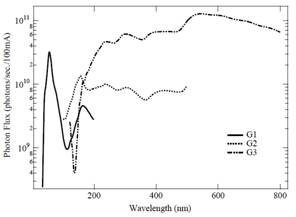
BL7B has been constructed to provide sufficiently high resolution for conventional solid-state spectroscopy,sufficient intensity for luminescence measurements, wide wavelength coverage for Kramers–Kronig analyses, and minimum deformation to the polarization characteristic of incident synchrotron radiation. This beamline consists of a 3-m normal incidence monochromator, which covers the vacuum ultraviolet, ultraviolet, visible, and infrared, i.e., the wavelength region of 50 – 1000 nm, with three gratings (1200, 600, and 300 l/mm). Two interchangeable refocusing mirrors provide two different focusing positions. For the mirror with the longer focal length, an LiF or a MgF2 window valve can be installed between the end valve of the beamline and the focusing position. Figure 1 shows the absolute photon intensity for each grating with the entrance and exit slit openings of 0.5 mm. A silicon photodiode (AXUV-100, IRD Inc.) was utilized to measure the photon intensity and the absolute photon flux was estimated, taking the quantum efficiency of the photodiode into account.
Technical Data
| Monochromator | 3 m Normal-Incidence Monochromator |
| Wavelength Range | 1.2-25 eV (50-1000 nm) |
| Resolution | E / ΔE = 4000-8000 for 0.01 mm slits |
| Experiments | Absorption, reflection, and fluorescence spectroscopy, mainly for solids |
